 Frank Cochran's five children. At age eleven his family moved to Bell Gardens, California to join his brother Bill who had moved there when he got married after leaving the Military Service.
At the age of 12 Cochran wanted to join the school orchestra as a drummer, opted for the trombone when he discovered that he would have to take piano lessons in order to play drums.
When the director of the school band informed the family that Eddie didn't have the "lip" for trombone he suggested clarinet instead. Cochran refused to even consider it and stated that
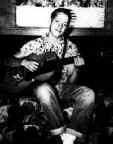 he would quit the band if he couldn't play what he wanted. He then asked his brother Bob to show him some chords on Bill's old Kay guitar. Then he got a chord book and seemed to just naturally take it from there".
In September 1951 he met Conrad Smith while attending junior high. Smith who shared the
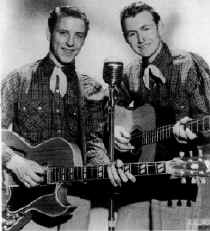
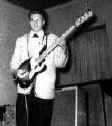 same interest in music as Eddie played upright bass in the school band and would later became his bass guitar player. In late 1953 they formed a trio together with another student on lead guitar, Connie on steel guitar and Eddie playing rhythm. They began playing country music as backup guitarists for singer Hank Cochran. Cochran began recording in 1955 with Hank Cochran (no relation) and they toured as the Cochran Brothers until 1956. After seeing Elvis Presley in Dallas in late 1955, Cochran switched to rock and roll. Cochran demonstrated his skill as a rockabilly guitarists at number of sessions in Los Angeles.
In the fall of 1956, while buying guitar strings in the Bell Gardens Music Center Eddie was introduced to Jerry Capehart, would later become his mentor, manager and co-writer.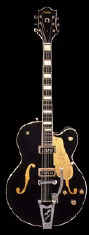 Capehart who couldn't sing was looking to for someone to demo his songs. Eddie said that he and Hank would for a small fee. Shortly thereafter, they recorded three or four songs, but nothing came of these dubs. Capehart knowing he never make it as singer attempted to form a relationship with the Cochrans by using them as a backing band and offering to promote their careers. Eddie and Hank split up in 1956.
While recording background music for a low budget film Boris Petroff, the producer, asked him to appear and sing his song "Twenty Flight Rock" in The Girl Can't Help,one of the first color rock and roll movies. September 8th 1956 he was signed a one year contract with Liberty Records. Cochran appeared in two other films: Untamed Youth in 1957 singing "Cotton Picker" and Go, Johnny, Go in 1959, singing Teenage Heaven."
His first hit was a cover of "Sittin in the Balcony" by Johnny Dee, which had strong regional sales. Cochran's more polished version won out charting at #18. Coming at the same time as The Girl Can't Help It established Cochran on the rock and roll scene.
Capehart who couldn't sing was looking to for someone to demo his songs. Eddie said that he and Hank would for a small fee. Shortly thereafter, they recorded three or four songs, but nothing came of these dubs. Capehart knowing he never make it as singer attempted to form a relationship with the Cochrans by using them as a backing band and offering to promote their careers. Eddie and Hank split up in 1956.While recording background music for a low budget film Boris Petroff, the producer, asked him to appear and sing his song "Twenty Flight Rock" in The Girl Can't Help,one of the first color rock and roll movies. September 8th 1956 he was signed a one year contract with Liberty Records. Cochran appeared in two other films: Untamed Youth in 1957 singing "Cotton Picker" and Go, Johnny, Go in 1959, singing Teenage Heaven."
His first hit was a cover of "Sittin in the Balcony" by Johnny Dee, which had strong regional sales. Cochran's more polished version won out charting at #18. Coming at the same time as The Girl Can't Help It established Cochran on the rock and roll scene.
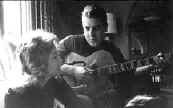
Eddie Cochran and Sharon Sheeley
June 11, 1958 "Summertime Blues" was released and then C'mon Everybody" both which were written by Cochran and Capehart. Cochran, an exceptionally talented guitarist, energetic stage performer, began touring extensively. A master of studio over dubbing Cochran sang all the parts on "C'mon Everybody" and "Summertime Blue".
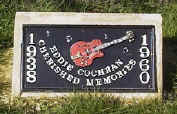
Memorial at crash site
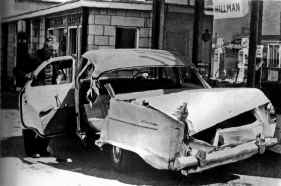 In early 1960 he toured the United Kingdom with his girlfriend, songwriter Sharon Sheeley, and fellow superstar performer Gene Vincent.The tour was a resounding success. Outside of London on the way to the airport to return to the United States, their cab was involved in a fatal accident in Chippenham, Wiltshire on April 17. Sheeley was not seriously hurt, but Vincent sustained injuries that left him with a limp for the rest of his life. Eddie Cochran was killed.
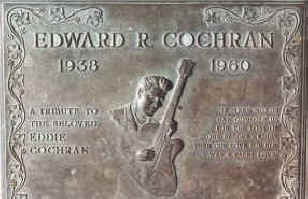
Gravestone at Forest Lawn Cemetery Cypress, California, USA
Eddie Cochran was inducted into The Rock and Roll Hall of Fame in 1987

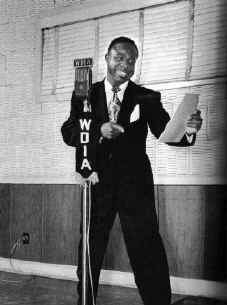
 piano, and later clarinet and alto saxophone, compose for big bands, as well as learning to read and write music in Braile. Orphaned at fifteen, Charles struck out on his own performing in bands around Florida. In 1948 at the age of seventeen Charles took his $600 savings and moved to Seattle. There he formed the Maxim trio, a group grounded in the style of Nat "King" Cole and Charles Brown. The Maxim Trio had a major R&B hit in 1949 with "Confession Blues" on the Downbeat (later Swing Time) label. It was during this time that he first began using Heroin. Charles toured with blues artist Lowell Fulson in the early '50s, having R&B hits with "Baby Let Me Hold Your Hand" and "Kiss Me Baby" on the small Los Angeles based Swingtime Label.
 he arranged and played piano on Guitar Slim's top R&B hit "The Things I Used to Do" for Specialty Records and formed his own band. In 1955 Charles had a hit in both the R&B and pop fields with his own composition "I've Got a Woman." Using top flight studio musicians Charles had hits consistently on the R&B charts through the late '50s with "A Fool for You," "Drown In My Own Tears," :Hallelujah I Love Her So," and "Lonely Avenue," The recording debut of his female backup group the Raelettes. He also became popular with jazz fans, recording two highly acclaimed records and performing a set at the 1958 Newport Jazz festival in 1959. Charles established himself as a popular recording artist and a pioneer of soul music with the release of his own top R&B/pop hit
 composition "What I Say."
 volume two was released and had crossover hits "You Are My Sunshine," "Your Cheating Heart," and "Take These Chains From My Heart." On ABC Charles had major pop hits with "Busted," "That Lucky Old Sun," "Crying Time," and "Together Again."
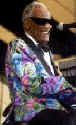 You," featuring himself and Chaka Khan. In the '90s Charles appeared in commercials for Pepsi and was the subject of a PBS documentary.
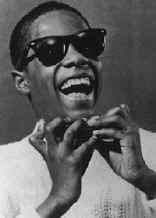 Harmonica Man," "Work Out Stevie, Work Out," and "Contract On Love" to name a few. In 1964 Wonder dropped the "Little" appellation. His late teen years saw continued success with "Uptight (Everything's Alright)," " For Once in My Life," "My Cherie Amour," and "Signed, Sealed, Delivered I'm Yours." Throughout this period Stevie worked on improving his skills as a singer, keyboardist, songwriter, and producer. In fact, he co-wrote most of his singles from 1967 onward, as well as the
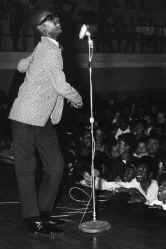 fund, he invested in his own publishing (Black Bull Music) and recording studio, Taurus Productions, ( where he could finance his own recordings. Stevie also took some music theory classes at USC to improve his song writing capabilities. Stevie recorded two albums on his own ( Where I'm Coming From and Music of My Mind) with the programming aid of Robert Margouleff and Malcolm Cecil. Margouleff and Cecil helped Stevie pioneer the use of synthesizers in popular music (most notably in Music of My Mind.) With these two albums, Stevie negotiated a contract with Motown that allowed him more freedom in artistic matters and a higher royalty percentage. Such a contract was nearly unheard of then, since Motown had a reputation of being merely a hit-making machine with little variety. Once the new contract was signed, Stevie released the two albums. Although the albums were not huge successes, Stevie showed signs of the genius that was about to come.
 released within the next year. This period was difficult for Wonder with his marriage to Wright ending after only a year. Injuries sustained in a serious car crash in 1973 left him in a coma for four days and a lost sense of smell. In the next four years, Wonder had three #1
 singles("You Haven't Done Nothin'", "I Wish", and "Sir Duke"), sold millions of each, and received 15 Grammies. His songs were covered widely and he was acknowledged as an influence on musicians from Jeff Beck to George Benson to Bob Marley. Working with
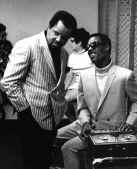 through chart-wise with two number one hits, the funky "Superstition" and the now standard "You are the Sunshine of My Life." The album was a big hit with the public. The power and emotion of the album in many ways shone true because many of the songs ("Blame It on the Sun," " Looking For a New Love," " I Believe") were written in reference to the relationship with his wife and former musical partner Syretta Wright. The programming of Margouleff and Cecil helped to represent these feelings in an all new manner.